
Introduction
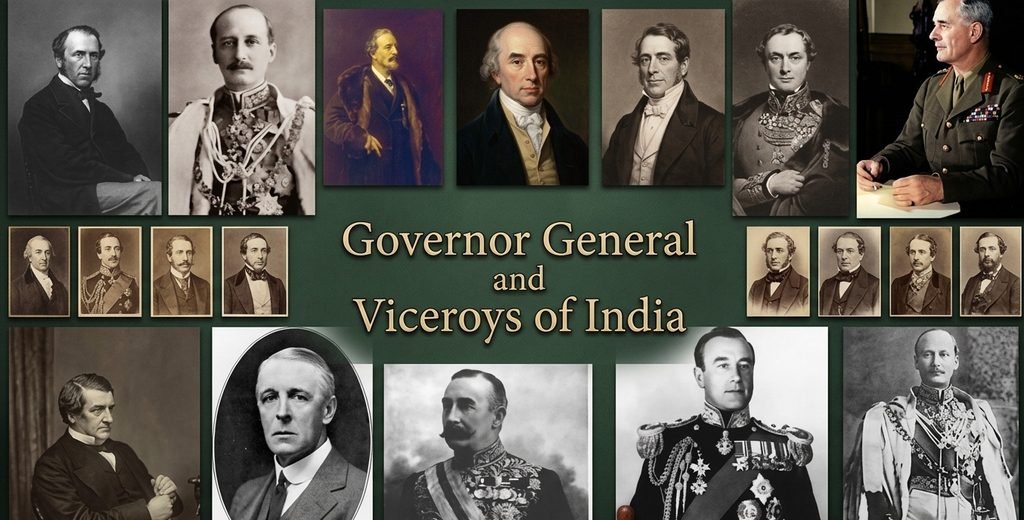
The Governor-General and Viceroys of India are important topics that are covered under the Modern Indian History and important for SSC and Railway exams. Questions are commonly asked about their tenures, important works during their reigns, reforms, and major events during British rule.
This article provides a chronological list of the important Governor-Generals and Viceroys of India, followed by their most important works and exam-focused one-liners.
Read the article: Important Battles in Indian History for SSC and Railway Exams
Governor-General and Viceroys of India: Quick Overview
- First Governor-General of Bengal: Warren Hastings
- First Governor-General of India: Lord William Bentinck
- First Viceroy of India: Lord Canning
- Last Viceroy of India: Lord Mountbatten
- Last Governor-General of independent India: C. Rajagopalachari
- Office of Viceroy created: Government of India Act, 1858
- Capital shifted from Calcutta to Delhi: During Lord Hardinge II’s tenure in 1911
Difference between Governor-General and Viceroy
The position of Governor-General was created by the Regulating Act 1773. Warren Hastings became the first Governor-General of Bengal under this system.
The Charter Act of 1833 changed the designation from Governor-General of Bengal to Governor-General of India. Lord William Bentinck was the first Governor-General of India.
After the Revolt of 1857, the British Crown took direct control of India from the East India Company through the Government of India Act, 1858. The Governor-General then also became the representative of the British Crown and was commonly called the Viceroy of India. Lord Canning was the first Viceroy.
| Governor-General of Bengal | 1773–1833 | Warren Hastings | Created by the Regulating Act of 1773 |
| Governor-General of India | 1833–1858 | Lord William Bentinck | Created by the Charter Act of 1833 |
| Viceroy of India | 1858–1947 | Lord Canning | Created after the Government of India Act, 1858 |
| Governor-General of independent India | 1947–1950 | Lord Mountbatten | C. Rajagopalachari was the last holder |
List of Governor-Generals of Bengal and India
| S.No. | Governor-General | Tenure | Important Events during their reign |
| 1 | Warren Hastings | 1772-85 | He was the first Governor-General of Bengal. Ended the dual system of administration Supreme Court was setup in Kolkata in 1774 Formed Asiatic Society in Bengal in 1784 First Newspaper (Bengal Gazette) was introduced. “Geeta” was translated to English by Charles Wilkins. Rohila War (1774) 1st Anglo- Maratha War (1776-82) 2nd Anglo-Mysore War (1780-84) |
| 2 | Lord Cornwallis | 1786-93 | Introduction of “Civil Services in India” (ICS) Also known as the “Father of Indian Civil Services” Introduced Permanent Settlement System (1793) Introduces Sunset Law 3rd Anglo-Mysore War (1792) |
| 3 | John Shore | 1793-98 | Introduce Charter Act of 1793 Battle of Kharda in 1795 between Nizams and Marathas |
| 3 | Lord Wellesley | 1798-1805 | Introduce concept of Subsidiary Alliance System (1798) Established Fort William College at Calcutta 4th Anglo-Mysore War (1799) 2nd Anglo-Maratha War (1803-05) |
| 4 | Sir George Borlaug | 1805-07 | The Acting Governor-General of India until the arrival of Lord Minto. First “Sepoy Mutiny” (1806) in Vellore Diminished the area of British territory because of his passion for economy and retrenchment, |
| 5 | Lord Minto-I | 1807-13 | Introduced the Charter Act of 1813 “Treaty of Amritsar” signed with Maharaja Ranjit Singh in 1809. Ended Trading Monopoly except Tea and Opium |
| 6 | Lord Hastings | 1813-23 | He was the last Governor General of Bengal Introduce the concept of” Ryotwari System” in 1820 by Henry Munro Adopt Policy of Paramountcy |
| 7 | Lord Amherst | 1823-28 | The annexation of Assam leading to the 1st Burmese war (1824-26) Cultivation of Tea in Assam The mutiny of Barrackpore in 1824 |
| 8 | William Benedict | 1823-35 | He was the First Governor-General of British India Abolished Sati Practice in 1829 “Suppression of Thugs” in 1830 Concept of Mahalwari System in 1833 in north-western Provinces and Bombay English was declared as official language by Lord Macaulay |
| 9 | Charles Metcalfe | 1835-36 | Removed all restrictions on “Vernacular Press Act” (1878) Also known as Liberator of Press India. |
| 10 | Lord Auckland | 1836-42 | 1st Anglo-Afghan War (1839-42) started and Britishers were completely defeated. Treaty with Sikhs. |
| 11 | Lord Ellenborough | 1842-44 | Sindh was annexed. |
| 12 | Lord Hardinge I | 1844-48 | 1st Anglo-Sikh War (1845-46) Prohibition of Female Infanticide |
| 13 | Lord Dalhousie | 1848-56 | Introduced “Doctrine of Lapse” Introduced 1st Telegraph System (Calcutta to Diamond Harbour) in 1853. Started Postal Stamp in 1854. Passed “Widow Remarriage Act” (1856) Appointed Education Commission (Wood’s Dispatch) in 1854 |
| 14 | Lord Canning | 1856-62 | He was the last Governor-General of British India. Three universities at Calcutta, Madras and Bombay in 1857 were established. Concept of Budget was started in 1860 by James Wilson “Income Tax Act” (1858) “Income Councils Act” (1861) Revolt of 1857 took place. |
List of Viceroys of India
| S.No. | Viceroy | Tenure | Important events during their reign |
| 1 | Lord Canning | 1858-62 | He was the first Viceroy of British India Three universities at Calcutta, Madras and Bombay in 1857 were established. Concept of Budget was started in 1860 by James Wilson. “Income Tax Act” (1858) “Income Councils Act” (1861) Revolt of 1857 took place. |
| 2 | Lord Elgin I | 1862-63 | Suppression of Wahabi Movement |
| 3 | John Lawrence | 1864-69 | Establishment of High court in Calcutta, Madras (1865) Bhutanese War (1864-65) Indian Forest Department were setup (1865) |
| 4 | Lord Mayo | 1869-72 | First Census (Irregular) in India (1872) Establishment of “Statistical Survey of India” Financial Decentralization in India First Viceroy in the Histroy who was killed during his reign. |
| 5 | Lord Northbrook | 1872-76 | Kuka Movement in Punjab (1872) Civil Marriage and Arya Samaj introduced. Intercaste Marriage allowed. Introduction of “Universal Marriage Act” (187) |
| 6 | Lord Lytton | 1876-1880 | Vernacular Press Act (1878), Arms Act (1878) Organised 1st Grand Durbar in Delhi (1877) Maximum age to take up civil services exam lowered from 21 to 19. Abolished tax on cotton for British traders |
| 7 | Lord Rippon | 1880-84 | 1st Census (regular) in India Passed the 1st Factory Act in 1881 Passed “Local Government Act” in 1882 Introduced the famous Ilbert Bill in 1883 Also known as the Father of Panchayati Raj System. |
| 8 | Lord Dufferin | 1884-88 | 3rd Burmese War (1885) “Indian National Congress” (INC) was founded in 1885. |
| 9 | Lord Lansdowne | 1888-94 | Passed the 2nd Factory Act in 1891 Indian Councils Act 1892 (Indirect election was introduced for the 1st time) Appointed Durand Commission in 1893 |
| 10 | Lord Elgin II | 1894-99 | Great Famine (Drought) in India occur in 1895 and so he appointed Lyall Commission He was killed by Chapekar (Ramkrishna & Damodar) Brothers. This was the first political murder. |
| 11 | Lord Curzon | 1899-1905 | Death of “Queen Victoria” in 1901 and he built Victoria Memorial in Calcutta Pass “Indian Coinage and Paper Currency Act (1899) Police Commission (1902) under Andrew Frazer Universities Commission (1902) under Thomas Railey Pass “Indian Universities Act” in 1904 Pass “Ancient Monument Protection Act” in 1905 Partition of Bengal (1905) |
| 12 | Lord Minto-II | 1905-10 | Swadeshi Movement started. Formation of All India Muslim League (1906) in Dhaka Morley- Minto Reform |
| 13 | Lord Hardinge -II | 1910-16 | Transfer of capital from Calcutta to Delhi (1911) Construction of Gateway of India to welcome King George V Partition of Bengal cancel (1911) Hindu Mahasabha was established (1915) by Madan Mohan Malviya. 1st Women University was started in Pune |
| 14 | Lord Chelmsford | 1916-21 | Home Rule League Movement started Champaran Satyagraha (1917) for Indigo cultivation. Kheda Satyagraha (1918) for Land Taxes Ahmedabad Satyagraha (1919) for Plague Passed Rowlatt’s Act in 1919 Montague-Chelmsford August Declaration (1917) Non-Cooperation Movement (1920) started |
| 15 | Lord Reading | 1921-26 | Khilafat Movement (1921) started. “Moplah Rebellion” (1921 in Kerala) took place. Chauri Chaura incident (1922) took place Swaraj Party (1922) was formed Kakori Train Incident (1925) took place |
| 16 | Lord Irwin | 1926-31 | Diwali Declaration (1929) Launch of Civil Disobedience Movement and Dandi March (1930) 1st Round Table Conference (1930) was held. |
| 17 | Lord Willingdon | 1931-36 | 2nd Round Table (1931) & 3rd Round Table (1932) was held. Poona Pact (1932) was signed between Dr. B.R Ambedkar & Mahatma Gandhi Communal Award was started Congress Socialist Party (1934) |
| 18 | Lord Linlithgow | 1936-1944 | 1st General Election (1936-37) Lahore Resolution (1940) Quit India Movement (1942) Cripps Mission (1944) |
| 19 | Lord Wavell | 1944-47 | C.R Formula (1944) Launch of “Direct Action day” (1946) INA Trials & Naval Mutiny (1946) Wavell Plan & Shimla Conference (1946) |
| 20 | Lord Mountbatten | 1947-48 | He was the last Viceroy and first Governor General of free India |
Important Firsts and Lasts
| First Governor-General of Bengal | Warren Hastings |
| First Governor-General of India | Lord William Bentinck |
| First Viceroy of India | Lord Canning |
| Last Viceroy of India | Lord Mountbatten |
| First Governor-General of independent India | Lord Mountbatten |
| Last Governor-General of independent India | C. Rajagopalachari |
| Viceroy during the Revolt of 1857 | Lord Canning |
| Viceroy known as Father of Local Self-Government | Lord Ripon |
| Viceroy during the Partition of Bengal | Lord Curzon |
| Viceroy during the Quit India Movement | Lord Linlithgow |
Important one-liners for SSC and Railway exams
- Warren Hastings was the first Governor-General of Bengal.
- Lord William Bentinck was the first Governor-General of India.
- Lord Canning was the first Viceroy of India.
- Lord Mountbatten was the last Viceroy of India.
- C. Rajagopalachari was the last Governor-General of independent India.
- The Permanent Settlement was introduced by Lord Cornwallis in 1793.
- The Subsidiary Alliance was introduced by Lord Wellesley.
- Sati was abolished during the tenure of Lord William Bentinck.
- The Doctrine of Lapse is associated with Lord Dalhousie.
- The Revolt of 1857 took place during Lord Canning’s tenure.
- The Vernacular Press Act was passed during Lord Lytton’s tenure.
- Lord Ripon is known as the Father of Local Self-Government in India.
- The Indian National Congress was founded in 1885 during Lord Dufferin’s tenure.
- The Partition of Bengal took place in 1905 during Lord Curzon’s tenure.
- Separate electorates were introduced by the Morley-Minto Reforms of 1909.
- The capital was shifted from Calcutta to Delhi in 1911 during Lord Hardinge II’s tenure.
- The Jallianwala Bagh massacre took place during Lord Chelmsford’s tenure.
- The Gandhi-Irwin Pact was signed during Lord Irwin’s tenure.
- The Quit India Movement began during Lord Linlithgow’s tenure.
- Lord Mountbatten announced the plan for the transfer of power in 1947.
Read the article: RRB NTPC CBT 2 Exam Date 2026: UG Schedule, Admit Card and Latest Updates
Practice MCQs
1. Who was the first Governor-General of Bengal?
A. Lord Cornwallis
B. Warren Hastings
C. Lord Wellesley
D. Lord William Bentinck
Answer: B. Warren Hastings
2. Who was the first Governor-General of India?
A. Warren Hastings
B. Lord Canning
C. Lord William Bentinck
D. Lord Dalhousie
Answer: C. Lord William Bentinck
3. Who introduced the Subsidiary Alliance System?
A. Lord Dalhousie
B. Lord Wellesley
C. Lord Curzon
D. Lord Cornwallis
Answer: B. Lord Wellesley
4. The Doctrine of Lapse is associated with which Governor-General?
A. Lord Dalhousie
B. Lord Ripon
C. Lord Lytton
D. Lord Auckland
Answer: A. Lord Dalhousie
5. Who was the first Viceroy of India?
A. Lord Mountbatten
B. Lord Canning
C. Lord Curzon
D. Lord Mayo
Answer: B. Lord Canning
6. Who is known as the Father of Local Self-Government in India?
A. Lord Ripon
B. Lord Curzon
C. Lord Dufferin
D. Lord Irwin
Answer: A. Lord Ripon
7. During whose tenure was Bengal partitioned in 1905?
A. Lord Minto II
B. Lord Curzon
C. Lord Hardinge II
D. Lord Lytton
Answer: B. Lord Curzon
8. During whose tenure was the capital shifted from Calcutta to Delhi?
A. Lord Curzon
B. Lord Chelmsford
C. Lord Hardinge II
D. Lord Dufferin
Answer: C. Lord Hardinge II
9. The Gandhi-Irwin Pact was signed during the tenure of:
A. Lord Reading
B. Lord Irwin
C. Lord Willingdon
D. Lord Wavell
Answer: B. Lord Irwin
10. Who was the last Viceroy of India?
A. Lord Wavell
B. Lord Mountbatten
C. Lord Linlithgow
D. Lord Canning
Answer: B. Lord Mountbatten
Frequently Asked Questions (FAQ’s)
Q1) Who was the first Governor-General of Bengal?
Ans: Warren Hastings was the first Governor-General of Bengal.
Q2) Who was the first Governor-General of India?
Ans: Lord William Bentinck was the first Governor-General of India under the Charter Act of 1833.
Q3) Who was the first Viceroy of India?
Ans: Lord Canning was the first Viceroy of India after the Government of India Act, 1858.
Q4) Who introduced the Doctrine of Lapse?
Ans: Lord Dalhousie introduced and applied the Doctrine of Lapse as a policy of annexation.
Q5) Who was the last Viceroy of India?
Ans: Lord Mountbatten was the last Viceroy of India.
Q6) Who was the last Governor-General of independent India?
Ans: C. Rajagopalachari was the last Governor-General of independent India..
Conclusion
The Governor-General and Viceroys of India are high-value topics for SSC and Railways exams. To revise effectively, remember each important officeholder together with one major event or reform.
The most important facts are: Warren Hastings was the first Governor-General of Bengal, Lord William Bentinck was the first Governor-General of India, Lord Canning was the first Viceroy, and Lord Mountbatten was the last Viceroy. Revise the tables, one-liners, and MCQs regularly to improve your Modern Indian History preparation.