
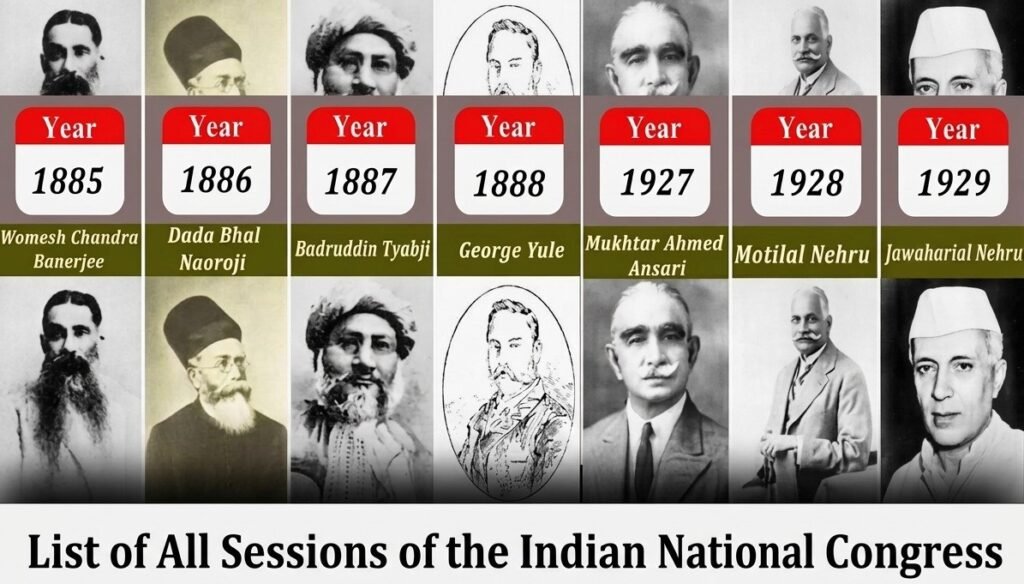
List of All Sessions of the Indian National Congress
The Indian National Congress (INC) sessions are an important part of Modern Indian History. Questions based on the year, venue, president and significance of a Congress session are frequently asked in upcoming SSC CHSL 2026, SSC CGL 2026 and Raliway exams.
The first session of the Indian National Congress was held in Bombay in December 1885 under the presidentship of Womesh Chandra Bonnerjee. Over time, the Congress sessions became important platforms for discussing constitutional reforms, the national movement, Swadeshi, Non-Cooperation, Civil Disobedience, complete independence and the Quit India Movement.
This article provides an exam-oriented list of the major annual and special sessions, followed by the most important facts and practice questions.
Read the article: Governor-General and Viceroys of India
Complete List of Indian National Congress Sessions
The 1st session of Indian National Congress was held in the year 1885 and take place at Gokuldas Tejpal Sanskrit College, Bombay. Wyomesh Chandra Banerjee was the President of the first session of INC and the 1st session was attended by 72 delegates.
List of All Sessions of the Indian National Congress: President and Important Facts
| Year | Place | President | Important Facts |
| 1885 | Bombay | W.C Banerjee | Attended by 72 Delegates |
| 1886 | Calcutta | Dadabhai Naoroji | Attended by 436 delegates |
| 1887 | Madras | Badruddiin Tayyabji | He was the 1st Muslim President of INC |
| 1888 | Allahabad | Sir George Yule | He was the 1st British President of INC |
| 1896 | Calcutta | Rahimtullah M Sayani | “Vande Mataram” sang for the 1st time. |
| 1899 | Lucknow | Romesh Chandra Dutt | ________ |
| 1901 | Calcutta | Dinshaw E.Wacha | For the 1st time, Mahatma Gandhi was seen on the stage |
| 1905 | Banaras | Gopal Krishna Gokhale | Swadeshi gained importance after the Partition of Bengal |
| 1906 | Calcutta | Dadabhai Naoroji | Swaraj, Swadeshi, Boycott and National Education were emphasised |
| 1907 | Surat | Ras Behari Bose | INC was divided into 2 parts- Moderate- Leader was Ras Behari Bose Extremist – Leader was Lala Lajpat Rai & Bal Gangadhar Tilak |
| 1910 | Allahabad | Sir William Wedderburn | M.A Jinnah decided the “separate electorate system” introduced by 1909 Act. |
| 1911 | Calcutta | B.N Dhar | “Jan-Gan-Man” sang for the 1st time in the session |
| 1915 | Bombay | Sir S.P Sinha | Moderates and Extremists move toward reunion |
| 1916 | Lucknow | A.C Majumdar | Re-Union of the “Indian National Congress” (INC), Lucknow pact signed, Gandhiji attended. |
| 1917 | Calcutta | Annie Besant | 1st women President of INC. |
| 1918 | Bombay | Syed Hasan Imam | _________ |
| 1919 | Amritsar | Motilal Nehru | Held after Jallianwalla Bagh tragedy |
| 1920 | Nagpur | C. Vijayaraghavachariar | M.A Jinnah left the INC. Gandhian programme was adopted. |
| 1922 | Gaya | Chittaranjan Das | Formation of “Swaraj Party” |
| 1923 | Delhi | Maulana Azad | Youngest President of INC. |
| 1924 | Belgaum | Gandhiji | Only Congress sesssion president over by Gandhi |
| 1925 | Kanpur | Sarojini Naidu | 1st Indian Women President of INC. |
| 1927 | Madras | Dr. M.A Ansari | Simon Comission boycott was decided |
| 1928 | Calcutta | Motilal Nehru | “All India Youth Congress” formed |
| 1929 | Lahore | Pandit Jawaharlal Nehru | Demanded “Poorna Swaraj” (Complete Independence) And pledge on Independence Day on 26 Jan.1930 |
| 1931 | Karachi | Sardar Vallabhbhai Patel | Gandhiji nominated to represent INC in 2nd “Round Table Conference” Approval of the Gandhi-Irwin Pact or Delhi Pact. |
| 1934 | Bombay | Rajendra Prasad | Formation of “Congress Socialist Party” |
| 1936 | Lucknow | Pandit Jawaharlal Nehru | Socialism and the national movement were discussed |
| 1937 | Faizpur (Maharashtra) | Pandit Jawaharlal Nehru | 1st session to be held in village. |
| 1938 | Haripura (Gujarat) | Subhash Chandra Bose | ____________ |
| 1939 | Tripuri (Madhya Pradesh) | Dr. Rajendra Prasad | Subhash Chandra Bose formed “All India Forward Bloc” |
| 1940 | Ramgarh (West Bengal) | Abdul Kalam Azad | “Quit India Movement” started in 1942. |
| 1946 | Meerut | J.B Kripplani | No regular annual session was held. |
| 1948 | Jaipur | P. Sitaramayya | First session after independence |
The first session of the Indian National Congress was held in Bombay in December 1885 under the presidentship of Womesh Chandra Bonnerjee. Later sessions played an important role in the development of the national movement, including the Swadeshi Movement, Non-Cooperation Movement, Civil Disobedience Movement and the demand for Poorna Swaraj.
Most Important Congress Sessions for SSC and Railway Exams
1. Bombay Session, 1885
The first session of the Indian National Congress was held at Gokuldas Tejpal Sanskrit College in Bombay from 28 to 30 December 1885. Womesh Chandra Bonnerjee presided over the session. A total of 72 delegates attended it.
2. Calcutta Session, 1906
Dadabhai Naoroji presided over the 1906 Calcutta Session. The four important demands associated with this session were:
- Swaraj
- Swadeshi
- Boycott
- National Education
This session is particularly important because it reflected the growing influence of assertive nationalism after the Partition of Bengal.
3. Surat Session, 1907
The Surat Session is associated with the split between the Moderates and Extremists. The session could not proceed smoothly because of differences over the choice of president and political methods. Rash Behari Ghosh was selected as president.
4. Lucknow Session, 1916
Ambika Charan Mazumdar presided over the Lucknow Session. Its two major outcomes were the reunion of the Moderates and Extremists and the Lucknow Pact between the Congress and the Muslim League.
5. Calcutta Special Session, 1920
Lala Lajpat Rai presided over this special session. The Congress approved the Non-Cooperation programme proposed by Mahatma Gandhi. The final organisational approval came at the Nagpur Session later in the same year.
6. Nagpur Session, 1920
C. Vijayaraghavachariar presided over the Nagpur Session. The Non-Cooperation Movement was adopted, and the Congress was reorganised through provincial committees based largely on linguistic regions. The membership structure was also made broader and more accessible.
7. Belgaum Session, 1924
Mahatma Gandhi presided over the Belgaum Session. It was the only Congress session presided over by Gandhi ji, making it the most repeated question in exams.
8. Madras Session, 1927
M. A. Ansari presided over this session. The Congress decided to boycott the Simon Commission and moved closer to the demand for complete independence.
9. Lahore Session, 1929
Jawaharlal Nehru presided over the Lahore Session. The Congress adopted Poorna Swaraj, or complete independence, as its objective. 26 January 1930 was observed as Independence Day, and the Civil Disobedience Movement was launched soon afterwards.
10. Karachi Session, 1931
Vallabhbhai Patel presided over the Karachi Session. The session adopted resolutions on Fundamental Rights and the National Economic Programme. These resolutions are considered an important early statement of the social and economic vision of independent India.
11. Faizpur Session, 1937
The Faizpur Session was the first rural session of the Indian National Congress. Jawaharlal Nehru presided over it. Its rural setting reflected the Congress’s effort to connect the national movement with peasants and villages.
Firsts Related to Indian National Congress Sessions
| First session of the INC | Bombay, 1885 |
| First president of the INC | Womesh Chandra Bonnerjee |
| First Muslim president | Syed Badruddin Tyabji, Madras Session, 1887 |
| First English president | George Yule, Allahabad Session, 1888 |
| First woman president | Annie Besant, Calcutta Session, 1917 |
| First Indian woman president | Sarojini Naidu, Kanpur Session, 1925 |
| Only session presided over by Mahatma Gandhi | Belgaum Session, 1924 |
| First session held in a rural area | Faizpur Session, 1937 |
| Session that adopted Poorna Swaraj | Lahore Session, 1929 |
| Session that adopted Fundamental Rights resolution | Karachi Session, 1931 |
| Session associated with the Lucknow Pact | Lucknow Session, 1916 |
| Session associated with the Moderates–Extremists split | Surat Session, 1907 |
Frequently Asked MCQs
1. Where was the first session of the Indian National Congress held?
A. Calcutta
B. Bombay
C. Madras
D. Allahabad
Answer: B. Bombay
2. Who presided over the first session of the INC?
A. Dadabhai Naoroji
B. A. O. Hume
C. Womesh Chandra Bonnerjee
D. Surendranath Banerjee
Answer: C. Womesh Chandra Bonnerjee
3. Who was the first Muslim president of the Indian National Congress?
A. Maulana Abul Kalam Azad
B. Syed Badruddin Tyabji
C. Hakim Ajmal Khan
D. Maulana Mohammad Ali
Answer: B. Syed Badruddin Tyabji
4. The Surat Split took place in which year?
A. 1905
B. 1906
C. 1907
D. 1909
Answer: C. 1907
5. The Lucknow Pact was associated with which Congress session?
A. 1907
B. 1916
C. 1919
D. 1920
Answer: B. 1916
6. Who presided over the Belgaum Session of 1924?
A. Jawaharlal Nehru
B. Vallabhbhai Patel
C. Mahatma Gandhi
D. Rajendra Prasad
Answer: C. Mahatma Gandhi
7. Poorna Swaraj was adopted at which session?
A. Madras, 1927
B. Calcutta, 1928
C. Lahore, 1929
D. Karachi, 1931
Answer: C. Lahore, 1929
8. Who presided over the Lahore Session of 1929?
A. Motilal Nehru
B. Jawaharlal Nehru
C. Subhas Chandra Bose
D. Vallabhbhai Patel
Answer: B. Jawaharlal Nehru
9. The resolution on Fundamental Rights was adopted at which session?
A. Karachi, 1931
B. Lahore, 1929
C. Faizpur, 1937
D. Haripura, 1938
Answer: A. Karachi, 1931
10. Which was the first rural session of the Indian National Congress?
A. Haripura
B. Faizpur
C. Tripuri
D. Ramgarh
Answer: B. Faizpur
11. Who presided over the Haripura Session of 1938?
A. Subhas Chandra Bose
B. Jawaharlal Nehru
C. Abul Kalam Azad
D. Rajendra Prasad
Answer: A. Subhas Chandra Bose
12. Who was the first woman president of the INC?
A. Sarojini Naidu
B. Annie Besant
C. Sucheta Kripalani
D. Aruna Asaf Ali
Answer: B. Annie Besant
Quick Revision Strategy
For SSC and Railway exams, revise the sessions in groups instead of memorising the entire table at once:
- Foundation group: 1885, 1887 and 1888 – first session, first Muslim president and first English president.
- Nationalist group: 1905, 1906 and 1907 – Swadeshi, four Calcutta resolutions and Surat Split.
- Reunion and Gandhian group: 1916, 1917, 1920 and 1924 – Lucknow Pact, Annie Besant, Non-Cooperation and Belgaum.
- Complete independence group: 1927, 1929 and 1931 – Simon Commission boycott, Purna Swaraj and Fundamental Rights.
- Final phase group: 1937, 1938, 1939 and 1940 – Faizpur, Haripura, Tripuri and Ramgarh.
Conclusion
The Indian National Congress sessions provide a clear timeline of the Indian freedom struggle. For competitive examinations, focus on the year, venue, president and one major event associated with each important session. The highest-priority topics are the first session of 1885, Surat Split of 1907, Lucknow Session, 1916, Non-Cooperation sessions, 1920, Belgaum Session,1924, Lahore Session, 1929 and Karachi Session, 1931.
Revise the tables regularly and practise the MCQs to improve accuracy in SSC and Railway Modern History questions.