
Introduction
The atmosphere is a thick gaseous envelope surrounding the Earth and extending thousands of kilometres above its surface. Its main constituents are nitrogen and oxygen, which account for 99% of its total volume.
The layers of the atmosphere are an important topic in Geography and Static GK. Questions related to the atmosphere are frequently asked in SSC, RRB, NTPC, Group D, and other competitive examinations. A clear understanding of the order, height, temperature, and special features of each layer can help candidates answer both direct and conceptual questions.
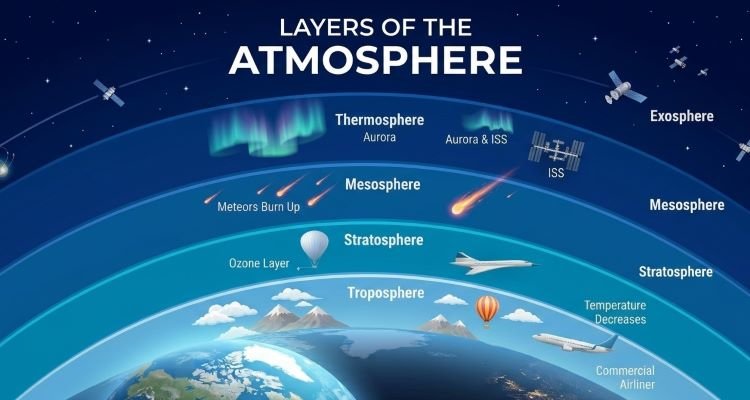
The Earth’s atmosphere is a protective layer of gases that regulates temperature, drives weather, screens solar radiation, and provides life-sustaining oxygen and carbon dioxide. Based on thermal and physical properties, it is structured into five distinct layers.
- Troposphere
- Stratosphere
- Mesosphere
- Thermosphere/Ionosphere
- Exosphere
Read the next article: Interior Structure of the Earth
What Is the Atmosphere?
The atmosphere is a mixture of gases held around the Earth by gravitational force. It mainly contains nitrogen and oxygen. Nitrogen makes up approximately 78% of the atmosphere, while oxygen accounts for about 21%. The remaining 1% includes argon, carbon dioxide, water vapour, and other gases.
Lacking a sharp upper boundary, the atmosphere gradually thins with altitude until it merges with space. Its layers are defined primarily by temperature variations.
Different Layers of the Atmosphere
Read on to learn about each layer in detail, along with its specific temperature and density.
1. Troposphere (8-18 km)
The troposphere is the lowest layer of the atmosphere and the layer closest to the Earth’s surface. It extends from the surface up to an average height of about 8 kilometres near the poles and 18 kilometres near the Equator. Its average upper limit is generally taken as about 12 kilometres.
The troposphere contains nearly 75% of the total mass of the atmosphere and most of the atmosphere’s water vapour and dust particles. Almost all weather-related activities, including clouds, rainfall, thunderstorms, cyclones, and snowfall, take place in this layer.
Temperature decreases with height in the troposphere. The average rate of decrease is about 6.5°C for every kilometre of ascent. This rate is called the normal lapse rate.
The upper boundary of the troposphere is known as the tropopause. The height of the tropopause is greater over the Equator because of stronger convection and warmer air, while it is lower over the poles.
Important facts about the troposphere
- It is the lowest layer of the atmosphere.
- It contains most of the atmosphere’s water vapour.
- All major weather phenomena occur in this layer.
- Temperature decreases with increasing height.
- The tropopause is its upper boundary.
2. Stratosphere (50 km)
This is the second layer of the atmosphere and lies above the troposphere. It extends to about 50 km. This layer is free from major weather phenomena and clouds, and therefore it is considered ideal for flying jet airways.
This layer is comparatively stable and contains very little water vapour, which is why clouds and weather activities are generally absent in the stratosphere.
The most important feature of the stratosphere is the ozone layer. The ozone layer absorbs a large part of the Sun’s harmful ultraviolet radiation.
Unlike the troposphere, temperature increases with height in the stratosphere. This happens because ozone absorbs ultraviolet radiation from the Sun and converts it into heat. The stratosphere provides favourable conditions for the movement of large aircraft because it has relatively little turbulence and fewer clouds. Its upper boundary is called the stratopause.
Important facts about the stratosphere
- It lies above the troposphere.
- The ozone layer is found in this layer.
- Temperature increases with height.
- The stratopause is its upper boundary.
3. Mesosphere (50-90 km)
The Mesosphere layer extends to a height of 50-90 km. Temperature decreases with height. It reaches a minimum of -80 degrees at a height of 80-90 km.
The mesosphere is widely known as the layer in which most meteoroids burn up. When meteoroids enter the atmosphere at high speed, friction with the gases in the mesosphere produces heat and makes them glow. This is why the mesosphere is sometimes called the region of shooting stars, although the objects are actually meteoroids and not stars.
The mesosphere is the coldest atmospheric layer. The upper limit of the mesosphere is called the mesopause.
Important facts about the mesosphere
- It lies between the stratosphere and thermosphere/Ionosphere.
- Most meteoroids burn up in this layer.
- Temperature decreases with height.
- It is the coldest layer of the atmosphere.
- The mesopause is its upper boundary.
4. Thermosphere/Ionosphere (80-640 km)
This layer lies at 80 km to 640 km above the surface of Earth. Temperature increases rapidly with increasing height and reaches up to 14800 C.
This layer is often considered the hottest layer of the atmosphere. This increase in temperature is because the gas molecules in this layer absorb the X-rays and Ultraviolet radiation of the Sun. This results in the breaking of gas molecules into positively and negatively charged particles, and therefore this layer is also known as the ionosphere.
It also acts as a protective layer against meteorites coming towards the Earth’s surface. Radio waves transmitted from Earth are reflected; thus, radio communication is possible in this layer.
Auroras, such as the Northern Lights and Southern Lights, occur mainly in the upper atmosphere, especially in the thermosphere, when charged particles from the Sun interact with atmospheric gases. Many artificial satellites and the International Space Station orbit in the thermosphere or nearby regions, depending on their orbital height.
Important facts about the thermosphere/Ionosphere
- Temperature increases rapidly with height.
- Auroras occur in the upper atmosphere in this region.
- It absorbs high-energy solar radiation.
- Radio communication is influenced by the ionosphere.
5. Exosphere (500-700 km and upward)
The exosphere is the outermost layer of the atmosphere. It begins at approximately 500–700 kilometres above the Earth and gradually extends into outer space. There is no clearly defined upper boundary of the exosphere.
The gases in the exosphere are extremely thin. Hydrogen and helium are the most common gases in this layer. Because the particles are widely separated, they can travel long distances without colliding with one another.
Many artificial satellites orbit in the exosphere. The exosphere forms the transition zone between the Earth’s atmosphere and outer space.
Important facts about the exosphere
- It is the highest and outermost layer of the atmosphere.
- It gradually merges with outer space.
- Hydrogen and helium are common gases here.
- Air density is extremely low.
- Several artificial satellites move through this region.
Layers of the Atmosphere: Quick Comparison
| Layer | Approximate Height | Temperature Trend | Major Feature |
|---|---|---|---|
| Troposphere | Surface to 8–18 km | Decreases with height | Weather and clouds |
| Stratosphere | 50 km | Increases with height | Ozone layer |
| Mesosphere | 50–90 km | Decreases with height | Meteoroids burn up |
| Thermosphere/Ionosphere | 80-640 km | Increases with height | Auroras and Satellites |
| Exosphere | About 500–700 km upward | Very high but extremely thin | Transition to space |
Why Is the Atmosphere Important?
The atmosphere is essential for life and the Earth’s climate system. It provides oxygen for respiration and carbon dioxide for photosynthesis. It also filters harmful solar radiation, maintains a suitable temperature, and supports the water cycle.
The atmosphere helps burn many incoming meteoroids before they reach the surface. It also enables weather and climate processes, carries sound waves, and supports communication through the ionosphere. Without the atmosphere, the Earth would face extreme temperature differences between day and night and life as we know it would not be possible.
Frequently Asked Questions on the Layers of the Atmosphere
Q1) Which is the lowest layer of the atmosphere?
Ans: The troposphere is the lowest layer of the atmosphere.
Q2) In which layer does weather occur?
Ans: Almost all weather phenomena occur in the troposphere.
Q3) In which layer is the ozone layer found?
The ozone layer is mainly found in the stratosphere.
Q4) Which is the coldest layer of the atmosphere?
Ans: The mesosphere is generally considered the coldest layer of the atmosphere.
Q5) In which layer do most meteoroids burn up?
Ans: Most meteoroids burn up in the mesosphere.
Q6) Which is the outermost layer of the atmosphere?
Ans: The exosphere is the outermost layer of the atmosphere.
Practice MCQs on the Layers of the Atmosphere
1. Which layer of the atmosphere is closest to the Earth’s surface?
A. Stratosphere
B. Mesosphere
C. Troposphere
D. Thermosphere/Ionosphere
Answer: C. Troposphere
2. The ozone layer is mainly located in the:
A. Troposphere
B. Stratosphere
C. Mesosphere
D. Exosphere
Answer: B. Stratosphere
3. Most meteoroids burn up in the:
A. Mesosphere
B. Troposphere
C. Exosphere
D. Stratosphere
Answer: A. Mesosphere
4. Which layer is the coldest layer of the atmosphere?
A. Troposphere
B. Stratosphere
C. Mesosphere
D. Thermosphere/Ionosphere
Answer: C. Mesosphere
5. The outermost layer of the atmosphere is called the:
A. Ionosphere
B. Exosphere
C. Mesosphere
D. Stratosphere
Answer: B. Exosphere
6. In which layer does temperature generally increase with height because of ozone absorption?
A. Troposphere
B. Stratosphere
C. Mesosphere
D. Exosphere
Answer: B. Stratosphere
Conclusion
The layers of the atmosphere are a high-value topic for SSC and Railways examinations. Remember the order – troposphere, stratosphere, mesosphere, thermosphere/Ionosphere, and exosphere – and connect each layer with its key feature. The troposphere is associated with weather, the stratosphere with ozone, the mesosphere with burning meteoroids, the thermosphere/Ionosphere with the and auroras and artificial satellites and the exosphere with outer space and satellites.
Regular revision of these points and practice with objective questions can improve accuracy in Static GK and Geography sections. For competitive exams, focus especially on the order of the layers, temperature trends, atmospheric boundaries, ozone, meteoroids, and the ionosphere.
Exam Tip: Revise the five layers from bottom to top and memorise one identifying feature for each layer. This method makes most direct questions on the atmosphere easier to solve.