
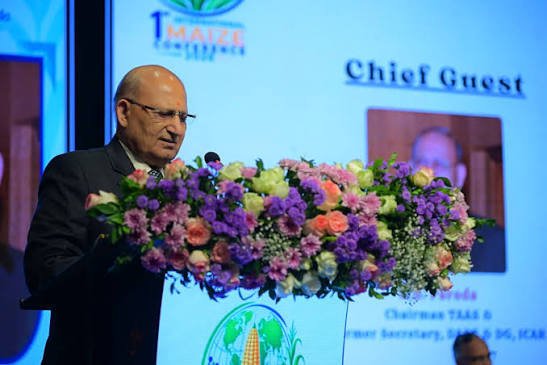
Telangana is hosting the first International Maize Conference 2026 at the JD Convention Centre in Hyderabad from November 2 to November 4, 2026.
Telangana Hosts First International Maize Conference 2026
Telangana is hosting the first International Maize Conference 2026 in Hyderabad from November 2 to November 4, 2026. The three-day conference is being held at the JD Convention Centre, Hyderabad, and brings together scientists, policymakers, agricultural institutions, industry representatives and other stakeholders connected with the maize sector.
The conference is being organised under the theme:
“Maize Revolution for Food, Feed, Fodder, Fuel and Sustainability in the Changing World”
The theme is also referred to as M4FS. It highlights the expanding importance of maize in food security, animal feed, livestock fodder, biofuel production, industrial applications and sustainable agriculture.
Read the next article: IIFA Awards 2026 Winners List
International Maize Conference 2026: Key Details
| Particular | Details |
|---|---|
| Conference | First International Maize Conference 2026 |
| Short Name | IMC 2026 |
| Venue | JD Convention Centre, Hyderabad |
| State | Telangana |
| Dates | November 2–4, 2026 |
| Theme | Maize Revolution for Food, Feed, Fodder, Fuel and Sustainability in the Changing World |
| Theme Abbreviation | M4FS |
| Main Focus | Maize productivity, research, sustainability and value-chain development |
| Expected Participation | More than 500 delegates |
| Major Crop | Maize |
The conference is being organised by the Maize Technologists Association of India, in collaboration with organisations including the Indian Council of Agricultural Research, Professor Jayashankar Telangana Agricultural University, the Trust for Advancement of Agricultural Sciences, the International Maize and Wheat Improvement Centre, and ICAR-Indian Institute of Maize Research.
Maize is one of the world’s most important cereal crops. It is used not only as food but also as livestock feed, poultry feed, fodder, industrial raw material and a source of bioenergy.
The conference aims to strengthen the complete maize value chain, from seed development and cultivation to processing, marketing and value addition. Important areas under discussion include:
- High-yielding maize varieties and hybrids
- Climate-resilient maize production
- Advanced breeding technologies
- Biotechnology and crop improvement
- Artificial intelligence in agriculture
- Mechanisation and smart farming
- Efficient use of water, fertilisers and other inputs
- Improved seed systems
- Nutritional quality of maize
- Maize-based food, feed, fodder and fuel
- Farmer income and market opportunities
- Sustainable production systems
According to the Indian Council of Agricultural Research, the conference is focused on improving maize productivity while ensuring better farm profitability and sustainable resource use.
Major Targets Discussed at the Conference
1. Increase India’s maize production to 75 million tonnes
India’s maize production has reached approximately 55 million tonnes. The conference highlighted the target of increasing production to 75 million tonnes over the next decade.
This target is expected to be supported by:
- Better crop management
- Improved seed quality
- Modern breeding methods
- Efficient use of agricultural resources
- Mechanisation
- Climate-resilient technologies
2. Improve productivity by 1.5 times
Another important target is to achieve a 1.5-fold increase in maize productivity through technological innovation, better cultivation practices and efficient resource utilisation.
For competitive examinations, candidates should remember that productivity refers to the amount of crop produced per unit of land.
3. Expand the 4F vision to 5F
Traditionally, maize has been associated with four major uses:
- Food
- Feed
- Fodder
- Fuel
The conference places Farmers at the centre of this model, creating a broader 5F approach:
- Food
- Feed
- Fodder
- Fuel
- Farmers
This approach focuses on ensuring that agricultural research and technological development improve farmer income and livelihoods.
4. Develop better maize hybrids
The conference also discussed the development of new maize hybrids with:
- Higher yields
- Improved nutritional value
- Resistance to pests and diseases
- Tolerance to drought and other climate stresses
- Better input-use efficiency
The ICAR highlighted that 329 maize hybrids had been developed through maize research and extension efforts in recent years.
5. Strengthen public-sector seed systems
Affordable and quality seed is essential for improving farm productivity. The conference stressed the need to strengthen public-sector hybrid seed production and build a reliable seed system for farmers.
A strong seed system can help farmers access:
- Certified seeds
- Climate-resilient varieties
- Region-specific hybrids
- Affordable planting material
- Better technical guidance
Maize and India’s Agricultural Economy
Maize is important for both agriculture and industry. It is used in the production of animal feed, poultry feed, starch, ethanol, processed food products and other industrial goods.
The crop also supports several sectors, including:
- Poultry and dairy farming
- Food processing
- Biofuel production
- Starch manufacturing
- Animal husbandry
- Rural employment
- Agricultural trade
The conference aims to promote stronger cooperation between research institutions, government agencies, farmers, industries and international organisations.
Role of Technology in Maize Production
Modern technology can help farmers deal with changing weather conditions and rising production costs. The International Maize Conference 2026 has given importance to several technology-based solutions.
Climate-resilient varieties
These varieties can perform better under drought, heat, irregular rainfall and other environmental stresses.
Artificial intelligence
AI can support farmers through:
- Weather forecasting
- Pest and disease detection
- Crop monitoring
- Yield prediction
- Precision farming
Mechanisation
Farm machinery can reduce labour requirements and improve the speed and efficiency of sowing, harvesting and processing.
Advanced breeding
Modern breeding techniques can help develop maize varieties with higher yield, improved nutrition and greater resistance to pests and diseases.
Importance for SSC and Railway Exams
The International Maize Conference 2026 is an important current-affairs topic for SSC, Railway, Banking, State PSC and other government examinations.
Questions may be asked from the following areas:
- Venue of the conference
- Host state
- Dates of the conference
- Conference theme
- Meaning of M4FS
- Organising institutions
- India’s maize production target
- 4F and 5F concepts
- ICAR-related facts
- Number of maize hybrids developed
- Uses of maize
- Sustainable agriculture and climate-resilient farming
Quick Revision Points
- Conference: First International Maize Conference 2026
- Venue: JD Convention Centre, Hyderabad
- State: Telangana
- Dates: November 2–4, 2026
- Theme: Maize Revolution for Food, Feed, Fodder, Fuel and Sustainability in the Changing World
- Theme Code: M4FS
- Production Target: 75 million tonnes
- Current Production Mentioned: Approximately 55 million tonnes
- Productivity Target: 1.5-fold increase
- Traditional Vision: 4F
- Expanded Vision: 5F, including Farmers
- Important Organisation: Indian Council of Agricultural Research
- Maize Hybrids Mentioned: 329
Practice MCQs for SSC and Railway Exams
1. The first International Maize Conference 2026 is being held in which city?
A. Bengaluru
B. Hyderabad
C. New Delhi
D. Pune
Answer: B. Hyderabad
2. Which state is hosting the International Maize Conference 2026?
A. Andhra Pradesh
B. Karnataka
C. Telangana
D. Maharashtra
Answer: C. Telangana
3. What is the theme of the International Maize Conference 2026?
A. Green Farming for New India
B. Maize Revolution for Food, Feed, Fodder, Fuel and Sustainability in the Changing World
C. Digital Agriculture for Farmers
D. Food Security through Organic Farming
Answer: B. Maize Revolution for Food, Feed, Fodder, Fuel and Sustainability in the Changing World
4. What does the 5F approach associated with the conference include?
A. Food, Feed, Fodder, Fuel and Farmers
B. Food, Forest, Fertiliser, Fuel and Farmers
C. Farm, Finance, Food, Fuel and Fertiliser
D. Food, Fish, Fibre, Fuel and Farmers
Answer: A. Food, Feed, Fodder, Fuel and Farmers
5. What production target for maize has been highlighted for India over the next decade?
A. 60 million tonnes
B. 65 million tonnes
C. 75 million tonnes
D. 100 million tonnes
Answer: C. 75 million tonnes
6. Which organisation is associated with agricultural research in India and is involved in the conference?
A. RBI
B. ICAR
C. SEBI
D. ISRO
Answer: B. ICAR
7. The International Maize Conference 2026 is being held from:
A. November 1–3, 2026
B. November 2–4, 2026
C. November 5–7, 2026
D. December 2–4, 2026
Answer: B. November 2–4, 2026
8. How many maize hybrids were mentioned in connection with recent maize research progress?
A. 129
B. 229
C. 329
D. 429
Answer: C. 329
Conclusion
The first International Maize Conference 2026 in Hyderabad is an important development for India’s agricultural research and maize sector. The conference focuses on raising maize production, improving productivity, supporting climate-resilient farming and increasing farmer income.
Its 5F approach, which adds Farmers to Food, Feed, Fodder and Fuel, reflects the importance of placing farmers at the centre of agricultural development. For SSC and Railway aspirants, the conference is an important current-affairs topic because it combines agriculture, science, technology, sustainability and national production targets.
Candidates should remember the venue, dates, theme, M4FS abbreviation, 75-million-tonne target, 1.5-fold productivity goal and 5F approach for quick revision.
Sources
- Indian Council of Agricultural Research, conference update and targets. 1st International Maize Conference 2026 Calls for Higher Productivity …
- Official International Maize Conference 2026 website. IMC 2026, 1st International Maize Conference, Hyderabad
- Maize Technologists Association of India conference information. 1st International Maize Conference 2026